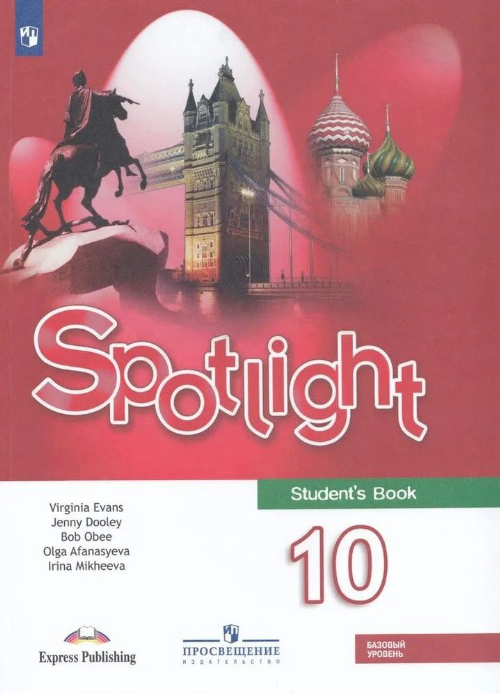
Стр.126-128 Модуль 4 ГДЗ Starlight Баранова 10 класс
Module 4. Focus on me
Reading. Task 1
- Match texts A–G with headings 1–8. Each number can be used once. There is an extra heading.
A Ballet originated in the royal courts of Italy in the 15th and 16th centuries, and later spread throughout Europe. It was brought to Russia by Peter the Great in the late 1600s. In Russia, ballet was not just entertainment in the courts; it became popular with the general public. By the early 1900s, ballet had taken on its own character in Russia and began to influence the rest of Europe.
B World War I and the 1917 revolution looked like the end of classical ballet in Russia. Some of the ballet’s most famous stars left Russia to continue their careers abroad. But ballet did not die out and eventually the artists returned and the Soviet government sponsored new ballet companies.
C Russia is home to some old and renowned ballet companies. The Mariinsky Ballet is the oldest, established in St Petersburg in 1740. The Bolshoi Ballet was founded in 1776 in Moscow but did not fully develop its identity until the 1900s. Today, the Bolshoi has a bold and colourful style, while the Mariinsky is more classical. Both ballet companies are among the top in the world.
D The Russian ballet is immediately recognisable. It is athletic, featuring more dynamic leaps and turns than Italian ballet, which focuses more on quick movements of the feet. It has also been influenced by Russian folk dances and folklore. Character dance, which uses techniques from the theatre, is also an important part of Russian ballet.
E An influential name in the history of ballet in Russia is Marius Petipa, a dancer, teacher and choreographer who worked as Ballet Master in the St Petersburg Imperial Theatre. The Sleeping Beauty and The Nutcracker are two of his most famous creations, but he also brought older works back to life in a new way.
F Anna Pavlova was born in St Petersburg in 1881. She was determined to become a ballet dancer, and after her studies, her talent and determination saw her rise to prima ballerina in just seven years. She was among the first Russian ballet dancers to tour the world. She also created her own ballet company, which gave her greater artistic freedom.
G The Vaganova method of teaching ballet is named after the Russian dancer Agrippina Vaganova, who developed it in the early 20th century. She had the original idea that students should focus on strengthening the centre of their body in order for the whole body to move in a natural, graceful way. This was quite innovative for its time. Today the Vaganova method is taught in ballet schools throughout the world.
- Leaders in the field
- An obviously national style
- Creating a new approach
- A quick rise to fame
- A brief history
- A legendary performance
- Reworking old themes
- Interrupted by politics
Grammar & Vocabulary. Task 1
- Read the texts given below. If necessary, transform the words written in brackets marked by numbers 1–7 to make them match grammatically with the contents of the texts. Each gap corresponds with a separate task from group 1–7.
The Railway Station
Lily put her bags down on the platform and looked at the station clock. There were only ten minutes until the train 1) … (depart). She told her boys, George and James, to guard the bags while she went for the tickets. Hurrying back to the platform with them, Lily tripped over someone’s travel bag, bruising her knee. The gentleman 2) … (who) bag it was helped her to her feet and asked her if she had hurt herself. At that moment George and James appeared, looking worried.
“We 3) … (wait) for ages! Are you alright?” they demanded.
“I’m sorry,” said Lily, 4) … (not mean) to frighten you. I’ve had a slight accident, I’m afraid.”
The Orient Express
The Orient Express was a long-distance passenger train between Paris and Istanbul. When it started 5) … (run) in 1883, it was a simple passenger service. Later on, however, its name 6) … (associate) with the height of elegance and luxury. Anyone traveling on board would be sure to come face to face with aristocrats and even royalty. The Orient Express enjoyed a long and glorious career and became a legend in its own time. Today, sadly, it 7) … (disappear) entirely from European train timetables, having made its last journey in December 2009.
Grammar & Vocabulary. Task 3
- Read the text and for gaps 1–7 choose the correct word.
Afternoon Tea
Harriet could not imagine a Saturday afternoon without her usual tea party. She would spend every Saturday morning shopping and preparing for the arrival of her guests 1) … later that day. She looked forward to it every weekend and went to 2) … great lengths to make it as special as possible. Today was no different. Her first port of call was the baker’s to buy fresh bread and cream cakes. Then she stopped by the local delicatessen to buy smoked salmon, cured meats and a good pâté for the sandwiches. Finally, she 3) … a visit to the excellent speciality tea shop on the village high street. She liked to 4) … her guests a different type of tea each week. This time she chose a delicate Darjeeling.
Once she had picked up all her supplies, Harriet went into her kitchen to get everything ready. Not only did the meal have to taste good, it had to look good too. She carefully removed the crusts from all the sandwiches and cut them into neat triangles before arranging them on her best china plates. The cream cakes were placed artistically on the cake stand to make them look 5) … more delicious than they already were.
When she had finished in the kitchen, Harriet went to 6) … the table. The dining table was covered in beautiful white linen to show 7) … her rose-patterned china tea service and she placed two bowls of fresh flowers at either end of the table.
Listening. Task 1
- You will hear six monologues. Match each speaker’s monologue A–F with statements given in the list 1–7. Each statement can only be used once. One statement is extra. You will hear the recording twice.
- I worry about paying for the things I have bought.
- I have changed my attitude towards shopping.
- I think online shopping needs more safety measures.
- I do not like shopping in a carefully planned way.
- I am careful about spending too much money.
- I do not mind the negative side to the way I shop.
- I have found a way to shop that suits my lifestyle.
Listening. Task 2
- You will hear a dialogue. Determine which of the given statements A–G correspond with the contents of the text (1—True), which do not correspond (2—False) and which are not given in the text, i.e. according to the text it is impossible to give either a positive or a negative answer (3—Not stated). You will hear the recording twice.
- Every Sunday, John cooks dinner for the homeless.
- Eating at the Royal Hotel is quite expensive.
- The restaurant staff receive a lot of tips.
- The hotel never throws any food away.
- The community centre depends on gifts from the youth club.
- Ruth’s mother is better at knitting than she is.
- John thinks that we should care about the homeless.
Speaking. Task 2 (3 minutes)
Study the advertisement.
Windy Bay Whale-Watching Excursions
- SEE MANY DIFFERENT KINDS OF WHALES AND OTHER MARINE LIFE!
- Operate all year round
- Marine experts on every trip
- Small groups only
- Advance reservations required
You are considering going on a whale-watching expedition and now you’d like to get more information. In 1.5 minutes, you are to ask five direct questions to find out the following:
- best time of year to go
- kinds of marine life
- if there are educational talks
- number of people per group
- how early to book
You have 20 seconds to ask each question.
Speaking. Task 4 (3.5 minutes)
Study the two photographs. In 1.5 minutes be ready to compare and contrast the photographs:
- give a brief description of the photos (action, location);
- say what the pictures have in common;
- say in what way the pictures are different;
- say which of the situations you would least prefer to be in;
- explain why.
You will speak for not more than 2 minutes (12–15 sentences). You have to talk continuously.
Writing. Task 2
Comment on the following statement:
Lessons on saving the environment should be compulsory in all schools.
People have done irreparable damage to wildlife on planet Earth. What is your opinion? Do you agree with this statement? Write 200–250 words.
Use the following plan:
- write an introduction (state the topic);
- express your personal opinion and give 2–3 reasons for your opinion;
- express an opposing opinion and give 1–2 reasons for this opposing opinion;
- explain why you don’t agree with the opposing opinion;
- write a conclusion restating your position.
1. A — 5, B — 8, C — 1, D — 2, E — 7, F — 4, G — 3. Extra heading — 6.
Grammar & Vocabulary
2.
1) There were only ten minutes until the train departed. — Past Simple after there were and in a past narrative.
2) The gentleman whose bag it was helped her to her feet. — whose shows possession.
3) We have been waiting for ages! — Present Perfect Continuous for an action that started in the past and is still relevant now.
4) I’m sorry, not meaning to frighten you. — participle clause.
5) When it started running in 1883, it was a simple passenger service. — after started we use the -ing form.
6) Later on, however, its name was associated with the height of elegance and luxury. — Passive voice in the past.
7) Today, sadly, it has disappeared entirely from European train timetables. — Present Perfect for a result in the present.
Grammar & Vocabulary
3.
1) later
2) great
3) paid
4) offer
5) even
6) set
7) off
Listening
4. A — 5, B — 6, C — 1, D — 7, E — 2, F — 3.
Listening
5.
- True
- Not stated
- True
- True
- True
- False
- True
Writing
Lessons on saving the environment should be compulsory in all schools.
In my opinion, this is absolutely true. Schools should teach children how to protect nature because the environment affects everyone’s life. First of all, students need to understand how serious pollution, climate change and the loss of wildlife are. If children learn about these problems early, they are more likely to become responsible adults. Secondly, environmental lessons can show pupils simple ways to help, such as saving water, recycling and reducing waste. Finally, this subject can encourage young people to take part in projects that improve their communities.
Some people believe that schools already have too many subjects and that environmental education is not as important as maths or science. They also think that children can learn about nature at home or from the media.
I do not agree with this opinion. Environmental problems are too important to be left outside the classroom. Besides, lessons on this topic do not replace other subjects; they support them and make learning more practical. In this way, students can see how knowledge is connected to real life.
To sum up, I strongly believe that saving the environment should be a compulsory part of school education because it helps young people understand their responsibility for the future of our planet.