

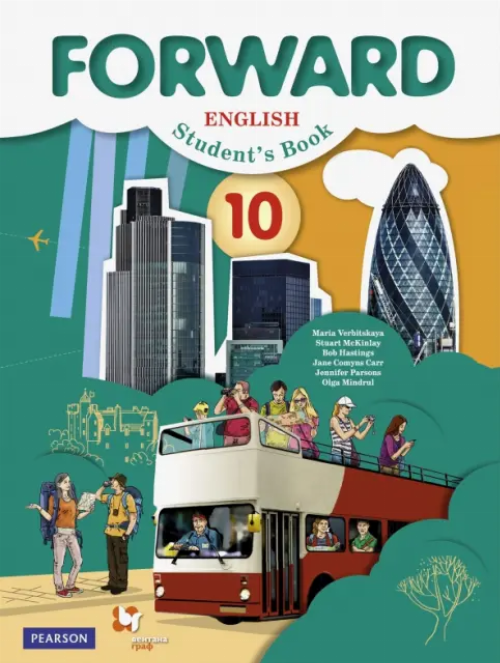
Стр.50-51 Unit 6 ГДЗ Вербицкая Forward 10 класс
Вербицкая, Маккинли, Хастингс
10 класс
Класс
10
Предмет
Английский
Автор
Вербицкая, Маккинли, Хастингс
Стр.50-51 Unit 6 ГДЗ Вербицкая Forward 10 класс
Задача
- You are visiting a capital city. In groups, decide what you would like to do from the list below.
- Museums (science, fashion, history)
- Art galleries (traditional, modern)
- Live music (pop/rock, jazz, classical)
- Theatre (comedy, drama, opera)
- Work in pairs. Look at the photos and read dialogues A–D. Which of the cultural activities in Exercise 1 is Jens enjoying?
- T036 Complete dialogues A–D with sentences 1–4. Then listen and check.
- do you know how much it costs to get in
- do you happen to know where the toilets are
- do you think I could have a look at your programme
- I wonder if you could give me change for a twenty-pound note
- Match direct questions a–d with indirect questions 1–4 in Exercise 3.
- Where are the toilets?
- Could I have a look at your programme?
- Could you give me change for a twenty-pound note?
- How much does it cost to get in?
- Write indirect questions. Use the questions and the phrases in brackets to help you.
- What are they talking about? (Have you any idea …)
- Was it really a good idea to give Shirley singing lessons? (I wonder …)
- How does it finish? (Can anyone tell me …)
- Have we come to the right place? (Are you sure …)
- Why did Juliet kill herself? (I’d like to know …)
- Work in pairs. Match two of the indirect questions in Exercise 5 to the cartoons below.
- T037 Write indirect questions. Use the questions and the phrases in brackets. Then listen and check.
- Could you do me a favour? (Do you think …)
- Could you wake me up in an hour?
- Why do we go out together?
- What did we do in the last class?
- When do we use indirect questions?
- What time is it?
- In pairs, complete the indirect questions with the words in brackets.
- In a cinema. Ask the ticket seller about the finishing time of the film you want to see. I wonder … (finish)
- In a restaurant. Ask the waiter for some salt.
- In an art gallery. Ask an attendant for directions to the Renaissance section.
- At home. The film has already started. Ask about the action so far.
- In an English class. Ask if anyone knows Shakespeare’s birthplace.
- In pairs, roleplay the conversation. Use indirect questions. Student A, look at page 120. Student B, look at page 121.
Подробный ответ
3. Complete dialogues A–D with sentences 1–4:
- A — do you happen to know where the toilets are
- B — do you think I could have a look at your programme
- C — I wonder if you could give me change for a twenty-pound note
- D — do you know how much it costs to get in
4. Match direct questions a-d with indirect questions 1-4:
- a — 2
- b — 3
- c — 1
- d — 4
5. Write indirect questions:
- Have you any idea what they are talking about?
- I wonder if it was really a good idea to give Shirley singing lessons.
- Can anyone tell me how it finishes?
- Are you sure we have come to the right place?
- I’d like to know why Juliet killed herself.
7. Write indirect questions:
- Do you think you could do me a favour?
- I wonder if you could wake me up in an hour.
- I’ve no idea why we go out together.
- Do you remember what we did in the last class?
- Could you tell me when we use indirect questions?
- Do you know what time it is?
8. Complete the indirect questions:
- I wonder if you could tell me what time the film finishes.
- Do you think you could bring me some salt, please?
- Could you tell me where the Renaissance section is?
- Would you mind telling me what has happened so far?
- Can anyone tell me where Shakespeare was born?
Grammar note: в indirect questions используется прямой порядок слов, как в утвердительном предложении, а не вопросительный.
Другие учебники
Другие предметы