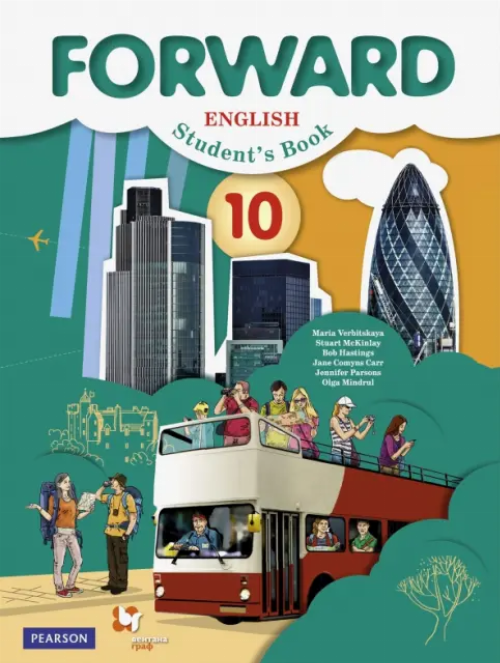
Стр.87 Unit 10 ГДЗ Вербицкая Forward 10 класс
Think Back! Match sentences a–g in Exercise 3 to meanings 1–7. What verb form do we use to show each of the meanings?
- prediction based on some evidence you have now;
- prediction based on opinions or expectations;
- plan or intention for the future;
- future arrangements;
- decision made at the moment of speaking;
- future event which is part of a timetable;
- in a subordinate clause after linkers like when, as soon as, before, after, the main clause contains a future form.
Work it out. Look at these sentences from the conversation. Which use the Future Continuous and which the Future Perfect? Complete rules 1–3 with the correct tense. Use Check it out on page 123.
- By the time we’re sixty, more people will be speaking Hinglish than ‘standard’ English.
- Will you have finished it by then?
- Will you still be working on it at 5.30?
- In 100 years’ time half the world’s languages will have disappeared.
- They’ll be bringing my little cousin.
Which pair of sentences has the same meaning? Explain the difference in meaning between the sentences in the other pairs.
- This time tomorrow you’ll be taking your driving test.
- This time tomorrow you’ll have taken your driving test.
- It’s June 20th: by the end of the month we’ll have finished our exams.
- It’s June 20th: in ten days’ time we’ll have finished our exams.
- When you get here, I’ll open my birthday presents.
- When you get here, I’ll be opening my birthday presents.
- They’ll buy the tickets on Saturday.
- They’ll have bought the tickets by Saturday.
Project idea
Prepare a presentation and/or make a poster ‘The languages of the world.’
Complete the predictions with the Future Continuous or the Future Perfect of the verbs in brackets. Which prediction is the most/least likely, do you think? Why?
By 2050
- most language schools … Chinese rather than English;
- American English … more important globally than British English;
- many English people … how to spell because of computer spell-checkers;
- English students … the language of text messages to write their essays;
- a minority of English speakers … English as we know it today;
- ‘isn’t it?’ … all other question tags.
Match sentences a and b to the sentences above them. Then explain the use of the future forms in each pair of sentences.
- Can you come back at 6.00?
- Can you wait for five minutes?
- I’ll finish this email, then we can go.
- I’ll have finished all my work by then.
- Sorry, only staff are allowed in here.
- I’ve got to go in and see the doctor now.
- OK, I’ll wait outside.
- OK, I’ll be waiting for you here when you come out.
- Mum’s going to phone at 7.00.
- Mum’ll be phoning later.
- She always does on Sunday afternoon.
- She wants to ask us about a birthday present for Jasmine.
- Phil and Sandra are arriving at 7.30.
- It’s 5.30 and Gabi’s plane arrives at 6.00.
- Is everything ready?
- You’re going to be late.
1. Future Perfect — действие будет завершено к определённому моменту в будущем.
2. Future Continuous — действие будет происходить в определённый момент в будущем и продолжаться после него.
3. Future Continuous — также используется для действий, которые произойдут как часть обычного хода событий.
6.
- Same meaning: 2a and 2b.
- 1a — действие будет происходить в конкретный момент в будущем.
1b — действие уже будет завершено к этому моменту. - 2a — к концу месяца действие завершится.
2b — действие завершится через десять дней от указанной даты. - 3a — я открою подарки, когда ты придёшь.
3b — я буду открывать подарки в момент твоего прихода. - 4a — они купят билеты в субботу.
4b — к субботе билеты уже будут куплены.
7.
- most language schools will be teaching Chinese rather than English.
- American English will have become more important globally than British English.
- many English people will have forgotten how to spell because of computer spell-checkers.
- English students will be using the language of text messages to write their essays.
- a minority of English speakers will be speaking English as we know it today.
- isn’t it? will have replaced all other question tags.
8.
- 1a — I’ll finish this email, then we can go.
1b — I’ll have finished all my work by then. - 2a — OK, I’ll wait outside.
2b — OK, I’ll be waiting for you here when you come out. - 3a — She always does on Sunday afternoon.
3b — She wants to ask us about a birthday present for Jasmine. - 4a — Is everything ready?
4b — You’re going to be late.
Future forms: will — spontaneous decision, promise or prediction; will be + V-ing — action in progress at a future time; will have + V3 — action completed by a future time; going to — future intention or prediction based on evidence.