

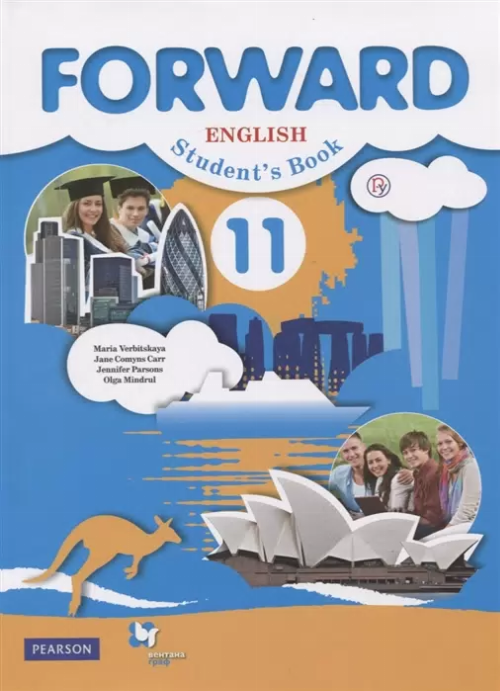
Стр.7 Unit 1 ГДЗ Вербицкая Forward 11 класс
Вербицкая, Камине Д.Карр, Парсонс
11 класс
Класс
11
Предмет
Английский
Автор
Вербицкая, Камине Д.Карр, Парсонс
Стр.7 Unit 1 ГДЗ Вербицкая Forward 11 класс
Задача
GRAMMAR AND VOCABULARY
- The Williams were interviewed for a TV programme British Families Today. Read extracts A—D and look at the family photos. Who’s talking in each case, and who are they talking about?
- Read the extracts again and answer the questions.
Who’s talking about
1) a generation gap?
2) a language barrier?
3) an age difference?
4) a relationship that has changed? - Work it out
The table contains various forms that can be used to express present and past habits. Complete it with examples from the texts.Habits in the present Habits in the past Present Continuous
1) ____will
3) ____Past Continuous
2) ____would
4) ____used to
5) ____ - Match the sentences from Exercise 3 to rules 1—3. Then find one more for each rule in the texts.
1) Past states and repeated past actions.
2) Behaviour which is typical or characteristic of the person
a) in the present
b) in the past.
3) Habits that are repeated more than usual and that the speaker finds annoying or unexpected
a) in the present.
b) in the past. - Look at sentences a and b and complete rules 1–3 with used to or would.
a) I used to feel more like a father than an older brother.
b) She used to spend time with the family — we’d watch TV and eat takeaway pizza together on a Saturday night.
1) We can introduce a new topic with ______ and we do not need to specify the time.
2) We do NOT use ______ to describe a past state.
3) We use ______ when the topic has been established and we usually specify the time. - Choose the verb forms which are NOT possible. In some cases both are possible.
When my sister was a teenager, there 1) ’d be/used to be a lock on our house phone to stop her making calls on it. Now she has her own phone, and her bills must be enormous: she 2) ’s talking/’ll talk on it for hours. She 3) ’d work/used to work as a hotel receptionist, and she 4) ’d tell/used to tell us funny stories about the hotel guests. Then one afternoon she 5) used to come/came home early because she had lost her job. Apparently, she 6) was always chatting/she’d chat on the phone instead of doing her work. - T001 Does Rachel agree with her brother Mark’s description of their relationship? Complete the gaps with suitable verbs. Then listen and check.
‘I’ve just read Mark’s interview, and I can’t believe what he said about his social life: I mean, all the girls used to 1) ______ feel sorry for him because he had to look after me, and they 2) ______ coming round to the house to help him! And as for taking his books and CDs without asking — well, he wouldn’t 3) ______ them to me because he said I was too young to look after them, so I’d 4) ______ them and hide them under the bed. I used to 5) ______ the way he treated me like a child, especially in front of his friends. It’s true that we get on better nowadays, but he’s still as bossy as he used to 6) ______, especially when it comes to boyfriends: he 7) ______ telling me what to do! It’s ironic, because one thing he doesn’t mention is that he often 8) ______ me for advice about how to deal with Sophie. He’ll 9) ______ me when Emily’s out and tell me all about the latest argument.’
SPEAKING AND VOCABULARY
- Work in pairs. In turn, choose a person on the photos on page 6 and describe him/her to your partner in 4–5 sentences. Can your partner guess who it is?
Подробный ответ
1) Mark is talking about his sister Rachel and their relationship.
2) Rachel is talking about Mark and their relationship.
1. a generation gap — Mark
2. a language barrier — Rachel
3. an age difference — Mark
4. a relationship that has changed — Rachel
3.
| Habits in the present | Example | Habits in the past | Example |
|---|---|---|---|
| Present Continuous | 1) is forever telling | Past Continuous | 2) were constantly coming round |
| will | 3) He’ll phone me | would | 4) we’d watch TV and eat takeaway pizza together |
| used to | 5) I used to hate the way he treated me like a child |
4.
1 — used to
2a — will, 2b — would
3a — Present Continuous, 3b — Past Continuous
6.
1) ‘d be — not possible
2) ‘ll talk — possible
3) ‘d work — possible
4) used to tell — possible
5) came — not possible
6) was always chatting — possible
7.
1) feel sorry for him
2) were constantly coming round
3) lend
4) steal
5) hate
6) be
7) is forever telling
8) asks
9) phone
Другие учебники



Другие предметы