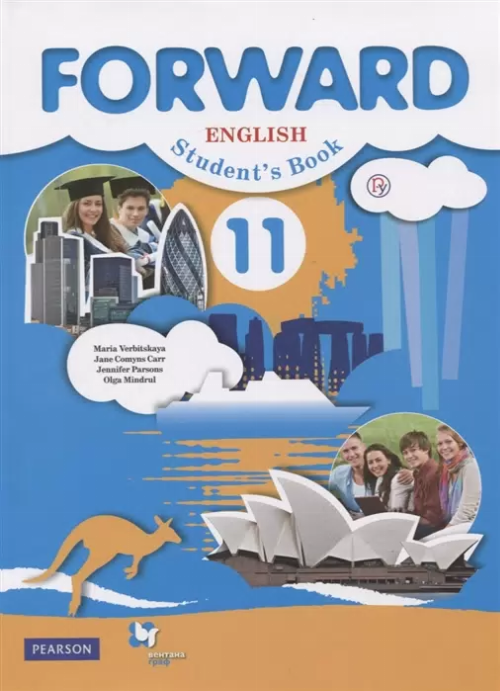
Стр.96 Unit 9 ГДЗ Вербицкая Forward 11 класс
Приведем выдержку из задания из учебника Вербицкая, Камине Д.Карр, Парсонс 11 класс, Просвещение: PART II
Rather against his better judgement, Jamie felt himself being drawn in. He could not resist Isabel, he had decided. There was something about her that fascinated him: the intellectual curiosity, the style, the verve.
‘So?’ he said. ‘So who is he? And what do we do?’
We do, he thought. I should’ve said you do, but once again, I’ve played straight into Isabel’s hands. I’m trapped. In nets of golden wires.
Isabel was oblivious of Jamie’s struggle with himself. She had invited him to meet her to discuss what she had found out; she had not asked him to join her in her inquiry. Of course, if he wished to do so, then that would be very helpful, but she had not asked him.
‘Well,’ she began, ‘we now know who that unfortunate young man was and where he lived. We know that the police appealed for information.’
‘And that’s it,’ said Jamie. ‘We … you don’t know whether they ever found the driver.’ Isabel conceded that this remained unknown. But now, at least, they had a description of the person who might have been responsible.
‘But what do you do with that?’ asked Jamie. ‘Go to the police? What would you tell them? That somebody else is having visions of a face and here’s a drawing?’ He laughed. ‘You can imagine the reception you’d get.’
Isabel thought about this. She had not imagined going to the police — just yet. Jamie was right in thinking that it would be difficult to convince them to take her seriously and that they would be unlikely to pursue the matter further; unless, of course, the push came from the family of the victim. If they could be persuaded to do something about it, then the police could hardly refuse a request from them, at least to consider Ian’s story.
Her thoughts were interrupted by Jamie. ‘Why are you doing this, Isabel?’ he asked mildly. ‘What’s the point?»
She looked at him. It was her duty, was it not? If this was really information about who was responsible for the hit-and-run incident, then surely she had a duty to do something about it any citizen would have that duty, simply because he or she was a citizen. And there was more to it than that. By listening to Ian’s story, she felt she had been drawn into a moral relationship with him and his situation. Isabel had firm views on moral proximity and the obligations it created. We cannot choose the situations in which we become involved in this life; we are caught up in them, whether we like it or not. If one encounters the need of another, because of who one happens to be or where one happens to find oneself, and one is in a position to help, then one should do so. It was as simple as that.
She shrugged. «The point is that I have to do this,’ she said. ‘I can’t walk away from it. That driver needs to be called to account. And Ian needs to know why he’s seeing that face. In each case, the solution lies in the uncovering of the truth.’
8 Complete the table. Some of the words are in the text. Then complete sentences 1-6 with the correct words from the table.
adjective
judgemental
conclusive
assumed
conceding
noun
rationale
concession
oblivion
verb
1 She instinctively made the assumption that he was telling the truth.
2 The results of the tests were conclusive. There was no doubt about it.
3 I try not to make assumptions/judgements about people until I get to know them better.
4 In the end, I was forced to concede that he was right.
5 We were oblivious of the fact that she was deeply hurt by our remarks.
6 I just don’t understand the rationale behind his behaviour.
9 In the extracts, find the words that match definitions a-h.
a unable to believe something (line 6)
b reply quickly and angrily (line 14)
c move one’s lip upwardly showing scepticism (line 37)
d energy and excitement (line 65)
e completely unaware of (line 71)
f admit reluctantly that something is true (line 83)
g nearness in distance or time (line 113)
h move one’s shoulders upwardly showing you don’t know or care (line 121)
10 Discuss your opinions in groups.
• Whose point of view do you sympathise with more — Jamie’s or Isabel’s?
• What would you do in her place?
• Do you ever find yourself in a dilemma? In what way?
• Do you find it easy to make up your mind about things or people? Why?/Why not? *Цитирирование части задания со ссылкой на учебник производится исключительно в учебных целях для лучшего понимания разбора решения задания.
Ответ
8.
| adjective | noun | verb |
|---|---|---|
| judgemental | rationale | assume |
| conclusive | concession | concede |
| assumed | oblivion | oblivious |
1. assumption
2. conclusive
3. assumptions / judgements
4. concede
5. oblivious
6. rationale
9.
- unable to believe something — incredulous
- reply quickly and angrily — retort
- move one’s lip upwardly showing scepticism — smirk
- energy and excitement — verve
- completely unaware of — oblivious
- admit reluctantly that something is true — concede
- nearness in distance or time — proximity
- move one’s shoulders upwardly showing you don’t know or care — shrug