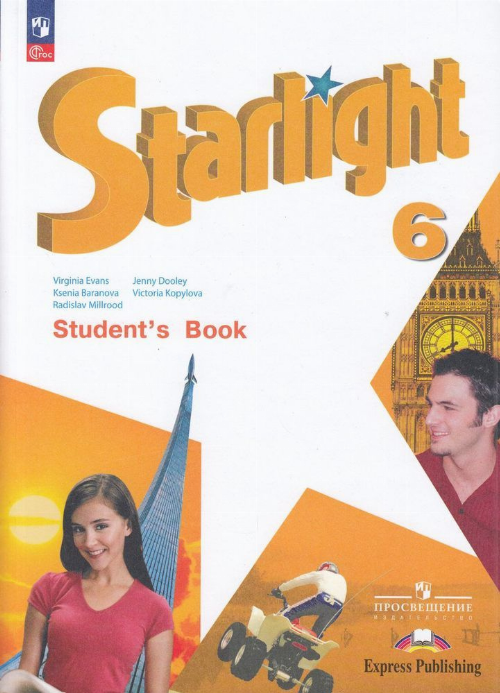
Стр.58-59 Модуль 3 ГДЗ Starlight Баранова 6 класс
Skills: Listening (True/False)
Read the rubric and the statements below. Find the key words and think of synonyms. Compare your synonyms with your partner.
You are going to listen to a radio news report about a bank robbery. Listen and say if the sentences (1–5) are T (true) or F (false).
- The robber went into the bank with a green bag.
- The police saw the robber escape on a train.
- The robber was casually dressed.
- There weren’t many people in the bank.
- Mary Robinson felt terrified.
- Do the task. Did you hear any of the words or phrases you thought of?
Reading: Matching headings to paragraphs
Read the rubric and heading A. Look at paragraph 6 and find words that paraphrase the words in the heading.
You are going to read a text about people who achieved unusual things. Match the headings (A–I) to the paragraphs (1–8). One heading does not match.
A FAST FOOD
B NO FEAR
C USING AN OLD TECHNIQUE
D A BIT OVERDRESSED!
E STILL GOING STRONG
F A BALANCING ACT
G NO CHALLENGE
H ONE NOT TWO
I GOING IN THE OPPOSITE DIRECTIONThere are a lot of people who went into the record books with their strange talents. Let’s read about some of them.
- Bored schoolchildren could learn a lot from Takuo Toda, who made a 10 cm paper aeroplane which flew for 26.1 seconds in Tokyo in December 2009. Takuo folded the plane from a single sheet of paper, using the traditional Japanese art of origami.
- Who says table tennis is just for kids? Australian table tennis player Dorothy De Low holds the Guinness World Record for the world’s oldest athlete. She took up the game at the age of 50 and she was still playing competitively in 2010, when she attended the World Veterans’ Championships in China — at the age of 100!
- Could you do a Rubik’s Cube in 11.97 seconds? American Chris Dzoan did it in January 2010, but the world record is 4.904 seconds. Maybe Dzoan isn’t the world’s fastest problem solver, but he has another talent: he broke the record for completing the cube with one hand.
- A German, Achim Artez, is a man who knows where he is going — but he can’t see where he’s going. Artez runs marathons backwards and in November 2009 he ran a half-marathon in Essen in 1 hour, 40 minutes and 29 seconds, a world record.
- Suresh Joachim from Sri Lanka achieved a record in May 1997. He spent 76 hours and 40 minutes standing with just one foot on the floor. And he didn’t fall over once!
- Englishman Ken Edwards ate 36 cockroaches in one minute on a British TV show in March 2001. The programme which showed his strange meal was a morning show called … The Big Breakfast!
- What do you think is a long swim? 5,000 metres? Slovenian Martin Strel swam a thousand times as far as that in 2007. He was the first person to swim all 5,268 km of the world’s most dangerous river, the Amazon, in 66 days. It was full of deadly crocodiles and piranhas, but Strel is a man who loves taking risks!
- In April 2008, in Belgium, Jef Van Dijck wore 227 T-shirts at the same time. He wanted to see how many he could put on at once. By the 227th T-shirt, you could hardly see his face!
- Now, complete the task.
Speaking: Role play
Read the table, then rewrite the direct questions below in your notebook as indirect questions, beginning with the words given.
- Is next Tuesday at 4 o’clock suitable? Can you tell me whether …
- What special equipment do you supply? Can I ask …
- What are your best achievements so far? I’d like to know …
Read the rubric. Think of words related to the theme. Then act out your dialogue. Follow the plan.
You are an international sports celebrity and you are going to give a talk at a school in Ireland. Talk to the school head teacher to arrange the visit.
Talk about:
- things you plan to talk about;
- equipment for giving the talk;
- date/time;
- age and sports interests of pupils.
A Headteacher
- Thank B for agreeing to come.
- Suggest dates and a time.
- Tell B.
- Suggest B talks about their family/home life.
- Ask if B needs anything else.
- Thank B and confirm date and time of talk.
B Sportsperson
- Ask when the talk takes place.
- Choose one of A’s dates and say why.
- Ask age and interests of pupils.
- Say what you plan to talk about.
- Refuse and give reasons.
- Ask about equipment you need.
- Mention one extra item.
- Thank A and say goodbye.
Writing: Formal letters
Number the biographical events in the order in which they usually appear.
- achievements
- university education
- date and place person died
- date and place person was born
- school(s) attended
- job/occupation
Read the rubric below and write a letter. Pay attention to the biographical information you include. Follow the plan.
The mayor of your town wants to name a new park after an important or famous person. He invites people of the town to send in their suggestions. Write a letter (120–150 words) in which you:
- give the reason for writing it and suggest someone to name the park after;
- give a short biography of the person;
- describe two of their achievements;
- give two reasons why you think they are a good choice.
Plan
Para 1: Give your suggestion for the park’s name
Para 2: Write a short biography of your chosen person; mention something positive which the person achieved
Para 3: Sum up their personality/personal qualities to show why they are a good choice.
1a) True / false:
- F
- F
- T
- T
- T
2b) Match the headings to the paragraphs:
- C
- E
- H
- I
- F
- A
- B
- D
3a) Indirect questions:
- Can you tell me whether next Tuesday at 4 o’clock is suitable?
- Can I ask what special equipment you supply?
- I’d like to know what your best achievements so far are.
4a) Biographical events in order:
- date and place person was born
- school(s) attended
- university education
- job/occupation
- achievements
- date and place person died
4b)
Dear Mayor,
I am writing to suggest that the new park should be named after Nelson Mandela.
Nelson Mandela was born in 1918 in South Africa. He studied at school and later at university. He worked as a lawyer and became one of the most important leaders in the fight for human rights.
One of his greatest achievements was helping to end apartheid in South Africa. He also became the country’s first black president. Mandela is a good choice because he was brave, kind and fair. He inspired millions of people around the world.
I think naming the park after him would be a wonderful idea.