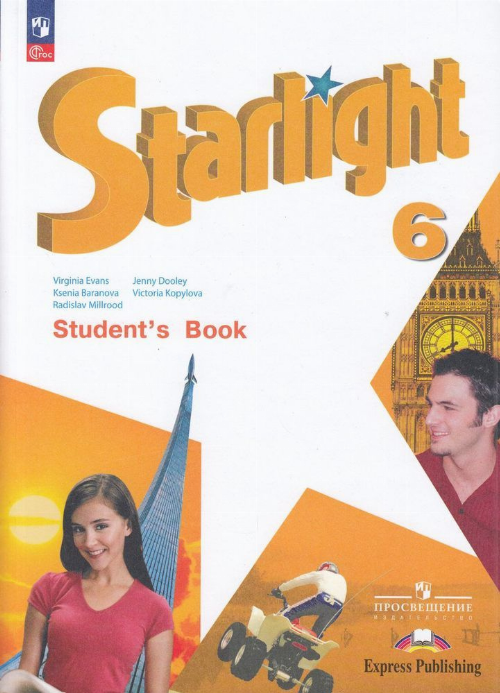
Стр.98-99 Модуль 6 ГДЗ Starlight Баранова 6 класс
6a Archaeological discoveries
- Listen and say. Make sentences, as in the example.
- clay
- wood
- terracotta (red clay)
- stone
- marble
- metal
- a) Look at the Terracotta Army. Where is it? What is special about it? Listen and read to find out.
The Terracotta Army
In 1974, a group of farmers in China were digging a well when they uncovered something strange: a life-sized statue of a soldier standing ready for battle. When the area was excavated later by archaeologists, one of the most incredible archaeological finds in history was revealed: a whole army of terracotta soldiers that had been undisturbed for over 2,000 years.
These statues were made to guard the tomb of Qin Shi Huang, the First Emperor of China. In ancient China, the dead were buried with their possessions because people believed that they could be taken into the afterlife with them. Qin Shi Huang wanted to be sure that he took all his belongings with him, including his army, so he ordered his men to start working on it when he was just 13 years old.
Around 700,000 men worked on building the elaborate treasure-filled tomb surrounded by an army of clay soldiers until the emperor’s death. Each one of the statues is unique. They each have their own individual facial expressions and features. Some have moustaches, others have beards, and they are all different heights and builds. Some people believe that each one was modelled on the real soldiers of the First Emperor’s personal army.
In total, there are around 8,000 soldiers all lined up for battle in different pits alongside bronze horses and chariots and an armoury of weapons spread over 50 square kilometres. The splendour of the burial site shows just how powerful Emperor Qin Shi Huang was.
During his reign he brought the different states of China together to form the first Chinese Empire and he made the written language, the money and the laws the same for everyone. The first great fortresses that would become part of the Great Wall of China were also built during his reign.
Strangely though, despite his importance and power, after his death, the emperor’s tomb was forgotten and remained untouched for 2,000 years. Today, the First Emperor’s Tomb is a protected UNESCO World Cultural Heritage site. Archaeologists may never uncover all the riches of the tomb, but what has been found so far is a fantastic gift to the world. Any visitor to China will be amazed by the spectacular terracotta army. It is a sight not to be missed.
Check these words: dig, life-sized, battle, excavate, reveal, guard, tomb, emperor, bury, elaborate, treasure-filled, unique, facial expressions, features, model, pit, chariot, armoury, splendour, burial site, reign, law, fortress, remain, untouched.
b) Read the text again and choose the correct answer A, B, C or D for questions 1–5.
- Who found the first life-sized statue?
A farmers
B soldiers
C archaeologists
D historians - Why were the clay soldiers buried?
A to guard the emperor’s body
B to protect the emperor’s army
C to protect the emperor’s belongings
D to follow the emperor into the next life - What is unique about the statues?
A They look like Qin’s real soldiers.
B Every one of them is different.
C They all look the same.
D Each one has a horse and chariot. - Emperor Qin …
A invented a written language.
B built the Great Wall of China.
C established a single currency.
D was remembered by his people. - The Terracotta Army …
A is a popular tourist sight.
B belongs to UNESCO.
C is protected from visitors.
D is only open to archaeologists.
- Who found the first life-sized statue?
- In pairs ask and answer questions based on the text.
- Think! Tell your partner three things you remember from the text.
- Read the theory. Find examples in the text.
- Complete with: is, was, were, will be, have.
- The Brothers Karamazov ______ written by Fyodor Dostoyevsky.
- The museum ______ opened by the mayor next week.
- Two buried statues ______ found last Monday.
- The site ______ visited by thousands every year.
- The invitations ______ already been posted.
- Rewrite the headings in your notebook using passive forms.
- Think! Imagine you were one of the Chinese farmers who discovered the Terracotta Army. Describe what you found and how you felt. Tell the class.
1. The vase was made of clay.
2. The vase was made of wood.
3. The vase was made of terracotta.
4. The vase was made of stone.
5. The vase was made of marble.
6. The vase was made of metal.
2b
- A farmers
- D to follow the emperor into the next life
- B Every one of them is different.
- C established a single currency.
- A is a popular tourist sight.
6
1. The Brothers Karamazov was written by Fyodor Dostoyevsky.
2. The museum will be opened by the mayor next week.
3. Two buried statues were found last Monday.
4. The site is visited by thousands every year.
5. The invitations have already been posted.
7
1. The tomb of the First Emperor was located near Xiang.
2. Over 8,000 soldiers are estimated to exist.
3. The army was buried over 2,000 years ago.
4. Archaeologists were amazed by the discovery in 1974.
5. The site is protected by UNESCO for future generations.
8
I was working with some other farmers. We were digging a well when I struck something hard. At first, I was surprised and a little frightened. Then we saw a life-sized statue of a soldier. We called the archaeologists, and later we found out that it was part of the Terracotta Army. I felt amazed and proud because we had discovered something so important.