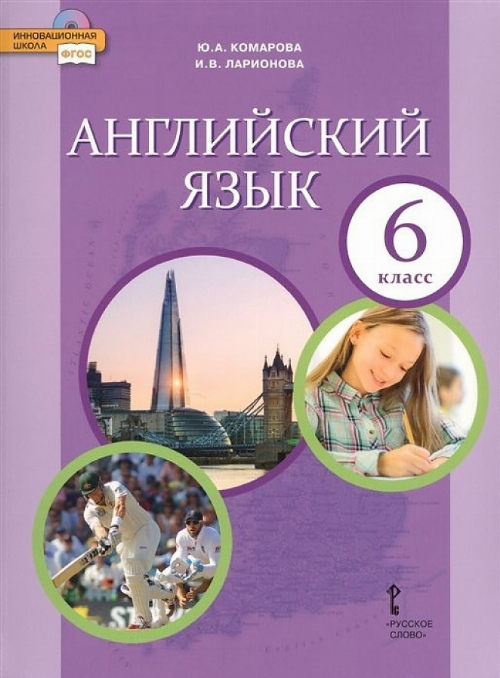
Стр.146-147 Across the curriculum ГДЗ Комарова Ларионова 6 класс
Across the curriculum: Climate zones
Match the words with the pictures.
- South Pole
- North Pole
- Equator
- Tropic of Cancer
- Tropic of Capricorn
- The tropics
- Storm
- Hurricanes
Read the descriptions and match them with the pictures.
- Tropical climates have high temperatures all year and high rainfall. Tropical areas are usually near the Equator. There are often storms and hurricanes in these areas.
- Monsoon climates have two seasons – wet and dry – but it is always warm. South East Asia, India and parts of Africa and South America have this type of climate.
- Dry climates have very low rainfall. The temperatures can be very hot or very cold. Deserts have this climate. A desert is any place with less than $$250\ \mathrm{mm}$$ of rain per year.
- In most of Europe and North America we have a warm climate – it isn’t too cold in winter or too hot in summer and it rains moderately. Parts of China and Australia also have this climate. This is the best climate for agriculture.
- Cool climates are in the far north of Europe and North America and the far south of South America and New Zealand. Here, the winters are longer and colder than in the warm climate areas.
- Cold climates have an average temperature of $$0^\circ\mathrm{C}$$ and are frozen all year round. The rainfall is low in these areas. Cold climate zones are situated at the Poles (North and South) and at the top of very high mountains.
Choose the correct answers.
Tropical climates have high rainfall.
- high rainfall.
- low rainfall.
- no rainfall.
The North Pole has got a cold climate.
- cool
- tropical
- cold
Monsoon climates have two seasons.
- two
- three
- four
A desert has less than $$250\ \mathrm{mm}$$ of rainfall per year.
- 100
- 50
- 250
The best climate for agriculture is a warm climate.
- monsoon climate.
- warm climate.
- cold climate.
Look at the climate graphs. Say if the statements are true or false.
- It rains a lot in Montreal in the summer.
- It is never above $$40^\circ\mathrm{C}$$ in Seville.
- The temperature changes every month in Singapore.
- It is always between $$10^\circ\mathrm{C}$$ and $$20^\circ\mathrm{C}$$ in Johannesburg.
- March is the rainiest month in Seville.
- In Singapore it rains a lot every month.
- In Montreal, the winters are cold but the summers are hot.
- The driest month in Johannesburg is May.
Project
You are going to make two climate graphs, one for your home city and one for a city in another climate zone.
Plan
- Make two copies of the climate graph below.
- Write the name of your city on one graph. Write the name of another city on the second graph.
Research
Find the information about rainfall and temperature in the two cities from newspapers, on the radio or TV or on the Internet, for example:
- www.meto.gov.uk/index.html
- www.worldclimate.com
- www.bbc.co.uk/weather
Prepare
Complete the graphs for each month.
- Record the rainfall by marking with a point in the appropriate places.
- Shade in the monthly temperature. Don’t forget to draw a line between all the rainfall points.
Present your material
Write a short text about the rainfall and temperature in the two cities and show it to your classmates and teacher.
1. South Pole — 1, North Pole — 2, Equator — 3, Tropic of Cancer — 4, Tropic of Capricorn — 5, the tropics — 6, storm — 7, hurricanes — 8.
2.
- Tropical climates.
- Monsoon climates.
- Dry climates.
- Warm climate.
- Cool climates.
- Cold climates.
3.
- a) high rainfall
- c) cold
- a) two
- c) 250
- b) warm climate
4.
- True
- True
- True
- False
- False
- True
- True
- True