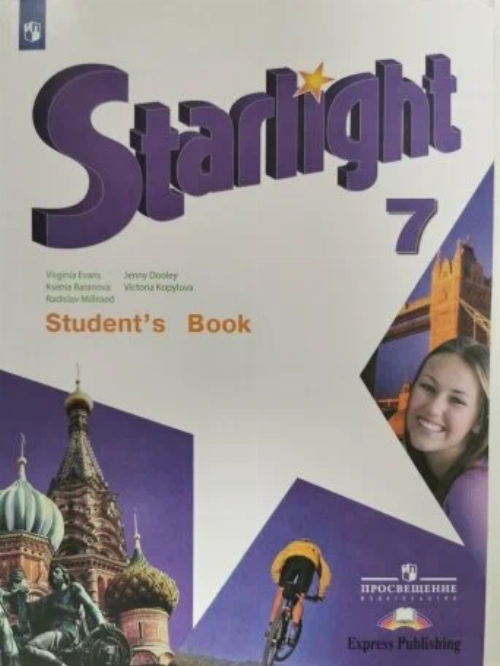
Стр.28-29 Модуль 2 ГДЗ Starlight Баранова 7 класс
Google was the brainchild of Larry Page and Sergey Brin. They met in 1995 at Stanford University, USA, while they were studying Computer Science. You could say Google started with an argument as, at first, Sergey and Larry didn’t really get on! In fact, they argued and disagreed on just about everything. However, there was one thing they did share: a commitment to making the Internet more user-friendly.
At that time, Internet search engines were slow and complicated. They listed search results according to the number of times the search term appeared on a page. Larry and Sergey found this frustrating. An idea came to them: why not list search results according to a website’s popularity? So, they set about creating a search engine that could calculate how important a particular web page was.
At first, their research received a fair amount of criticism from experts, but the two friends didn’t give up and managed to raise enough money from investors, family and friends to support themselves.
While they were developing the search engine, Larry and Sergey realised it needed a catchy name. They were inspired by a mathematical word, ‘googol’, which means ‘1 followed by a hundred zeros’. They thought it was a really good name, considering the endless amount of information available on the Net, and so ‘googol’ became ‘Google’.
In 1998, Larry and Sergey set up their office in a friend’s garage and Google went online. Soon, they were answering thousands of search requests per day. People really liked Google’s simple, neat design and, of course, its speedy performance! Before long, Sergey and Larry moved their operations to a new headquarters they called Googleplex.
In 2000, Google introduced ten foreign language versions and officially became the world’s most popular search engine. Google now responds to about a billion search requests per day and its success shows no signs of fading. For most people seeking information, Google is the place to go!
What is Google? What does its name mean? How do you think it got started? Listen and read to find out.
Read the text again and decide if the sentences below are T (true) or F (false).
- Larry and Sergey usually shared the same opinions.
- Google was the first search engine on the Net.
- From the very beginning, everybody thought Google was a good idea.
- It took a while for Google to become successful with Internet users.
Complete the sentences with words/phrases from the Check these words box.
brainchild, argument, search engine, commitment, user-friendly, complicated, frustrating, popularity, calculate, a fair amount, criticism, investor, catchy, inspired, neat, performance, headquarters, respond, fade
- Tell the class a short summary of the text.
- Imagine Google went down for a week. How would this affect the lives of those who use it every day? In three minutes write a few sentences. Tell the class.
Read the table. How do we form the negative and interrogative in the Past Continuous?
Form questions and full answers based on the text in Ex. 2, as in the example.
- Larry and Sergey/study/Maths in 1995?
- Search engines/list results/according to popularity/before Google?
- Larry and Sergey/work/from their house in 1998?
- People use Google/in 1998?
Use the words to ask and answer questions in pairs.
- you/study/9 o’clock yesterday evening?
Put the verbs in brackets into Past Continuous or Past Simple.
VKontakte
People first learnt about social networks at the end of the 20th century. While western users 1) … (receive) information from various sources, the Russian social network VK (short for VKontakte) 2) … (appear). People who 3) … (speak) different languages 4) … (start) to use it, but especially popular it 5) … (become) among Russian users. User registration was initially limited to university circles, but the site still 6) … (grow) quickly. The number of people who 7) … (want) to sign up 8) … (become) bigger with each year. At the beginning of 2021 the VK website 9) … (have) 97 million users all over the world and 10) … (get) the 1.5th place in the sphere of its popularity.
Read the theory. Find more examples in the text in Ex. 2.
Put the verbs in brackets into the Past Continuous or the Past Simple.
Facebook
In 2004, 23-year-old Mark Zuckerberg 1) … (launch) Facebook while he 2) … (study) at Harvard University. People 3) … (want) a university website with students’ profiles, so Mark 4) … (decide) to do something about it. 1,200 students 5) … (sign up) within 24 hours! He then 6) … (expand) the site to include other universities. Mark 7) … (face) some difficulties, though. Three Harvard seniors 8) … (insist) that while Zuckerberg 9) … (work) on a similar project with them, he 10) … (use) their ideas to create Facebook. This 11) … (not stop) Mark, though, and Facebook soon 12) … (become) the biggest social networking site in the world with 500 million users to date.
Think! Imagine you are the inventor of VKontakte. Describe the events leading up to your creation of this social network.
Think! Imagine you are Mark in Ex. 9. Describe the events leading up to your creation of Facebook. Tell your partner or the class.
2.
- F
- F
- F
- T
3.
- Google made the Internet more user-friendly for everyone.
- They thought of a catchy name to attract attention.
- It’s very frustrating when you can’t find the information you want on the Internet.
- The company’s new headquarters are in New York.
- The company’s plans received a lot of criticism, so they didn’t go ahead.
4a. Google was created by Larry Page and Sergey Brin. They wanted to make the Internet more user-friendly, so they developed a search engine that could rank web pages by popularity. At first, people criticised their idea, but later Google became the world’s most popular search engine.
4b. If Google went down for a week, many people would have problems finding information quickly. Students, workers and businesses would all be affected. People would need to use other search engines and spend much more time looking for answers.
6.
- Were search engines listing results according to popularity before Google? No, they weren’t. They were listing results according to the number of times the search term appeared on a page.
- Were Larry and Sergey working from their house in 1998? No, they weren’t. They were working in a friend’s garage.
- Were people using Google in 1998? Yes, they were. They were sending thousands of search requests per day.
9.
In 2004, 23-year-old Mark Zuckerberg launched Facebook while he was studying at Harvard University. People wanted a university website with students’ profiles, so Mark decided to do something about it. 1,200 students signed up within 24 hours! He then expanded the site to include other universities. Mark faced some difficulties, though. Three Harvard seniors insisted that while Zuckerberg was working on a similar project with them, he was using their ideas to create Facebook. This didn’t stop Mark, though, and Facebook soon became the biggest social networking site in the world with 500 million users to date.