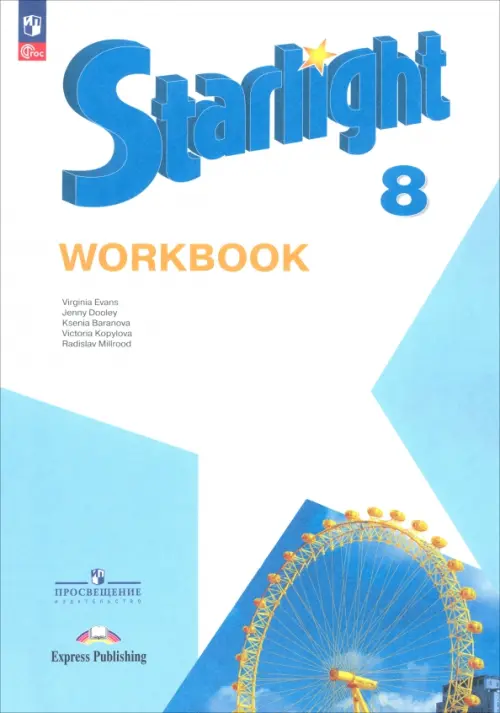
Стр.56-57 Модуль 3 ГДЗ Starlight Баранова 8 класс
- Say the names of the planets in our solar system. Listen and check.
- Read the title of the text and the quote. What could the problems of space colonisation be? How could these problems be solved? Read to find out.
“I don’t think the human race will survive the next 1,000 years unless we spread into space.” Stephen Hawking, English physicist & cosmologist
- For each gap 1–5, choose from the sentences A–F the one that best fits each gap. One sentence is extra. Compare with your partner. Justify your answers.
- A Humans would need to be self-sufficient to survive in space long-term.
- В The only question is whether this happens in years, centuries or millennia.
- C Exploring space, however, is not without risk.
- D Nevertheless, Professor Hawking believes that we can afford to give 0.25% of the world’s financial resources to colonise space.
- E Life there would be very harsh, though.
- F He believes that sooner or later we will be wiped out by a catastrophe such as a meteor or nuclear war.
- Complete with: self-sufficient, harsh, warm up, afford, release.
- Jupiter’s moons have ______ climates with ice fields, storms and acid rain, so it would be impossible to live there.
- The ISS isn’t ______ because it can’t produce or make everything that it needs.
- Climate change could ______ the Earth by 3°C by 2100.
- Power stations ______ carbon dioxide and other greenhouse gases into the atmosphere.
- Only the world’s richest can ______ to be a space tourist; it costs about $20 million!
- Find the correct word. Check in your dictionaries.
- ______ such as food and equipment are sent to the ISS from Earth.
- Hawking believes we can ______ all the problems and colonise space.
- Some scientists believe a huge asteroid or comet could ______ life on Earth.
- There are many options for colonising space; the possibilities are ______.
- Study the table. Find examples in the text.
- Rewrite the sentences using mixed conditionals, as in the example.
- Angie doesn’t like science-fiction films, so she didn’t go to the cinema with the others.
- Sam doesn’t have good eyesight, so he wasn’t accepted on the astronaut training programme.
- Mark didn’t hand in his project, so he won’t pass the astronomy course.
- Greg was studying all night, so he’s tired now.
- He can’t afford it, so he hasn’t applied to study abroad.
- Janet is interested in astronomy, so she visited the planetarium yesterday.
- Listen to and read the article in Ex. 3 again, then tell your partner three reasons why colonising space is difficult.
- Think! Close your eyes and imagine you’re in a spacecraft. What are you doing and what can you see and hear? How do you feel? Tell your partner.
- Think! Would you like to live in a space colony? Why/Why not? In a few minutes, write a few sentences on this topic. Read your sentences to the class.
1 – F
2 – E
3 – A
4 – D
5 – B
Разбор: F подходит после мысли о том, что человечество может не выжить; E логично продолжает идею о Луне; A объясняет, что для жизни в космосе нужно быть самодостаточными; D связывает проблему денег с мнением Хокинга; B завершает мысль о том, когда это может случиться.
4
1. Jupiter’s moons have very harsh climates with ice fields, storms and acid rain, so it would be impossible to live there.
2. The ISS isn’t self-sufficient because it can’t produce or make everything that it needs.
3. Climate change could warm up the Earth by 3°C by 2100.
4. Power stations release carbon dioxide and other greenhouse gases into the atmosphere.
5. Only the world’s richest can afford to be space tourists; it costs about $20 million!
5
1. Supplies such as food and equipment are sent to the ISS from Earth.
2. Hawking believes we can overcome all the problems and colonise space.
3. Some scientists believe a huge asteroid or comet could wipe out life on Earth.
4. There are many options for colonising space; the possibilities are endless.
7
1. If Angie liked science-fiction films, she would have gone to the cinema with the others.
2. If Sam had good eyesight, he would have been accepted on the astronaut training programme.
3. If Mark had handed in his project, he would pass the astronomy course.
4. If Greg hadn’t been studying all night, he wouldn’t be tired now.
5. If he could afford it, he would have applied to study abroad.
6. If Janet weren’t interested in astronomy, she wouldn’t have visited the planetarium yesterday.
Разбор: В смешанных условных предложениях соединяются разные времена: например, условие в прошлом, а результат — в настоящем, или наоборот.
8
Colonising space is difficult because colonies would have to be self-sufficient. Life there would be very harsh. There is no atmosphere on the Moon, and Mars has similar problems. Also, space travel is still extremely expensive and very slow.
10
I would like to live in a space colony because it would be exciting to explore a new world and see Earth from space. However, it would also be very difficult because life there would be harsh and we would have to be completely self-sufficient.