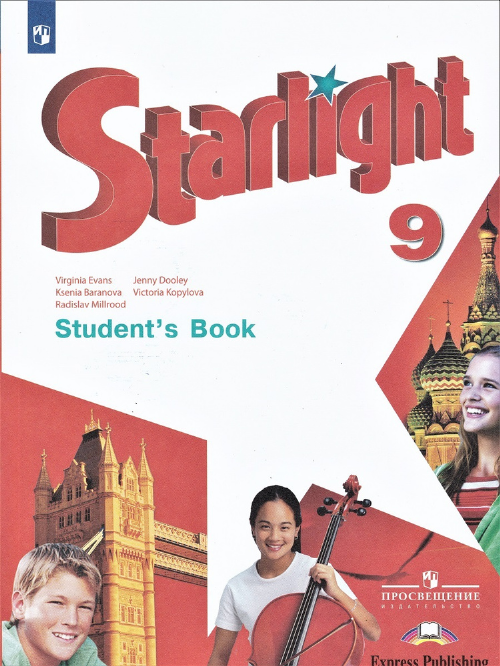
Стр.122-124 Модуль 6 ГДЗ Starlight Баранова 9 класс
Reading
- Read the title of the article and the first sentence of each paragraph. What do you expect the article to be about? Listen and read to find out.
Stone Age holidays - Read the text. Decide which of the statements (1–8) are T (True), F (False) or NS (Not stated), meaning that you can’t give a clear answer to them.
1. Manuel thought the soup tasted good.
2. The prehistoric camp participants have to hunt animals for food.
3. Archaeologists aren’t sure what prehistoric man wore.
4. Manuel says that our ancestors were not inventive.
5. The writer didn’t really enjoy cave painting.
6. Manuel thinks people don’t appreciate what Neanderthals achieved.
7. The writer feels that he/she learnt valuable skills on the holiday.
8. Manuel recognised what the writer had made. - Match the words in bold in the text with the words/phrases below.
Speaking
- Read the rubric and find the key words, then take turns to do the task in pairs. Evaluate each other’s performance by answering the questions below.
1. Did he/she include all the points asked for in the rubric?
2. Did he/she use a friendly, confident tone and look you in the eye?
3. Did he/she use correct pronunciation/intonation?
4. Did he/she use appropriate phrases to structure their discourse, e.g. In my opinion. Also, I believe?Give a 2-minute talk about the importance of history. Remember to say:
how important history is as a school subject;
what period of history you are most interested in and why;
what your favourite historical place or site in your country is and why. - Take part in a telephone survey. You have to answer six questions. Give full answers to the questions. Remember that you have 60 seconds to answer each question.
Electronic Assistant: Hello. This is the electronic assistant from City Break Tours speaking. We would like you to take part in our survey. We need to find out about how people feel about going on holiday in cities. Please answer six questions. The survey is anonymous and you do not need to give your name. So, let’s begin.
Electronic Assistant: Could you tell me how old you are, please?
Student: …
Electronic Assistant: What kind of holidays, short breaks or excursions do you normally enjoy going on?
Student: …
Electronic Assistant: What kind of activities would you enjoy doing while on a trip to a city?
Student: …
Electronic Assistant: Do you prefer value for money over a high standard of food and accommodation?
Student: …
Electronic Assistant: What kind of evening entertainment would be popular with young people on a city break?
Student: …
Electronic Assistant: What’s the best holiday or short break you’ve ever had?
Student: …
Electronic Assistant: That is the end of the survey. Thank you very much for your assistance.
Word formation
- Read the text below. Form derivatives from the words in brackets so that they fit the text. Complete the gaps with those new words. Every gap corresponds to a different task (1–6).
It is very 1) ________ that fashion has existed since humans first started walking on two legs! Figurines from the Stone Age seem to suggest that young women were 2) ________ dressed and wore bracelets around their arms, for instance. Up until 800 BC, however, clothes were mostly made from plain-coloured fabrics, but then one 3) ________ revolutionized the ancient fashion world. The Phoenicians, located in the Middle East, discovered that a black substance contained in sea snails could be turned into a rich purple clothes dye. In no time, ‘Tyrian Purple’ turned the Phoenician city-state of Sarepta into a 4) ________ trading city. Rulers and the 5) ________ from across the Mediterranean offered a high price for these textiles, which had become a symbol of power and status. Although the dye eventually disappeared, it led to a desire for 6) ________ luxury textiles that continues to this day. So, maybe that makes Sarepta the first fashion capital of the world!
Listening
- You’ll hear 4 short dialogues A, B, C and D twice. Match the dialogues with the locations where they take place (1–5). You can only use each location once. There is one extra location.
1. at a museum
2. on a cruise ship
3. on a bus during a city tour
4. at a travel agent’s
5. at a train station
Writing
- Read the rubric and find the key words, then complete the task.
You have received a letter from your English-speaking pen friend Jake.
“So, it’s back to school after the half-term break. I had a great long weekend in Paris with my family. It was an unforgettable experience. What city would you most like to visit and why? Would you rather go on a city break with your family or as a school trip and why? What are the best kinds of activities to do when visiting a city?”
Write him a letter and answer his 3 questions (100–120 words).
1. The article is about holidays during which people pretend to live in the Stone Age and learn primitive skills.
2. Reading
- NS
- F
- T
- F
- NS
- T
- NS
- F
In statement 2, hunting is illegal in the area, so the menu is mainly vegetarian. In statement 4, Manuel says that Palaeolithic people liked innovations and knew how to adapt to their environment. In statement 8, Manuel thought the writer had made a shoe, but it was actually a soup bowl.
3. Vocabulary
| Meaning | Word from the text |
|---|---|
| not advanced | primitive |
| new ways of doing things | innovations |
| developed over time | evolved |
| really interested in | passionate about |
| had difficulty speaking clearly | spluttered |
| OK to eat | edible |
4. Speaking
History is an important school subject because it helps us understand the world and learn from the mistakes of the past. It shows us how our society has developed and gives us a better idea of who we are. In my opinion, studying history also helps us respect different cultures and traditions.
I am most interested in the history of Ancient Rome. I enjoy reading about the Roman Empire, its military strategies and its influence on many countries. I would like to visit Rome and see the Colosseum, where gladiators fought in the past.
My favourite historical site in my country is Kizhi Pogost on Lake Onega in Karelia. It is famous for its beautiful wooden churches dating from the eighteenth century. It is a UNESCO World Heritage Site and a very special place.
- Yes, all the points were included.
- Yes, the speaker used a friendly, confident tone and looked at the listener.
- Yes, the pronunciation and intonation were correct.
- Yes, the speaker used suitable phrases such as In my opinion, Also and I believe.
5. Telephone survey
Electronic Assistant: Hello. This is the electronic assistant from City Break Tours speaking. We would like you to take part in our survey. We need to find out how people feel about going on holiday in cities. Please answer six questions. The survey is anonymous, so you do not need to give your name. Let’s begin.
Electronic Assistant: Could you tell me how old you are, please?
Student: I’m sixteen years old.
Electronic Assistant: What kind of holidays, short breaks or excursions do you normally enjoy going on?
Student: I enjoy family trips to new cities. I like visiting museums, trying local food and going on walking tours.
Electronic Assistant: What kind of activities would you enjoy doing while on a trip to a city?
Student: I would enjoy visiting historical sites, trying street food and taking a bike tour to see the city from a different perspective.
Electronic Assistant: Do you prefer value for money to a high standard of food and accommodation?
Student: I think value for money is important, but basic comfort, cleanliness and good local food are important too.
Electronic Assistant: What kind of evening entertainment would be popular with young people on a city break?
Student: Young people would probably enjoy local markets, street performances, cinemas and open-air concerts.
Electronic Assistant: What’s the best holiday or short break you’ve ever had?
Student: The best short break I’ve ever had was in Rome. I visited ancient ruins, tried delicious gelato and enjoyed the city’s art and history.
Electronic Assistant: That is the end of the survey. Thank you very much for your assistance.
6. Word formation
- likely
- beautifully
- discovery
- powerful
- wealthy
- colourful
7. Listening
Для точного выполнения задания необходим аудиоматериал с диалогами A, B, C и D. Без записи нельзя достоверно соотнести диалоги с местами.
8. Writing
Dear Jake,
Thanks for your letter. I’m glad you had such a great weekend in Paris. I’d most like to visit Tokyo because I’m interested in Japanese culture and technology. It would be exciting to see the mixture of ancient traditions and modern life. I would rather go on a city break with my family because we always have fun together and can share unforgettable experiences. When visiting a city, the best activities are exploring historical sites, visiting museums and trying local food. I would also like to walk around the city centre and take lots of photos. Write back soon and tell me more about your trip to Paris.
Best wishes,
Nikita