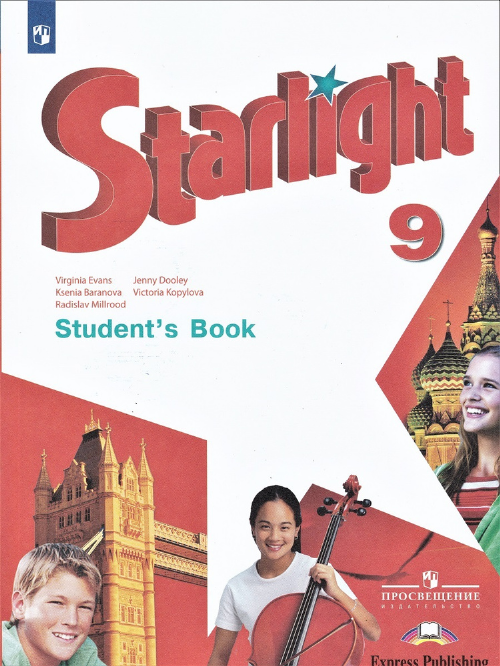
Стр.82-84 Модуль 4 ГДЗ Starlight Баранова 9 класс
Look at the picture. Have you seen ‘living statues’ like this performing in the street? What do you think life as a living statue would be like?
Life is a living statue
Since the 1980s, stony-faced performers have haunted the streets of Britain. Alix Buscovic has a go at standing still.
“A stranger might give you a hard time and most of us get hit once or twice a year.” Ed Johnson’s warning makes it sound like life as a living statue could be pretty risky. Fortunately, I’ll have the protection of Matt Walters, who’s been standing still professionally for over 25 years.
“Don’t let people see your eyes flicker or your chest move,” says Matt. Sadly, unlike him, I don’t have a heart rate so slow you can barely detect his pulse and nor do I have Ed’s ability to go for half an hour without blinking.
However, it’s not just about standing still. “It’s more about what you do when you move,” says ex-drama teacher Ed. “If you do something spectacular, it amazes people.” Ed’s costumes take him weeks to make; I have just three days to make a costume, train myself to be motionless and work on some crowd-pleasing actions. Oh, and fit in some drama training.
“To be any good, you have to get inside a character,” says Matt, whose street character, a chimney sweep, is “a grumpy old man.”
These days, both Ed and Matt work mainly in the world of corporate events — but they still enjoy the street, where ‘statuing’ in its present form began in the 1980s. So popular is the art nowadays that it even has its annual international championship, held in Holland.
Stationary performance can be traced back to the medieval mystery plays, in which scenes were recreated by groups assembled in silent, still living pictures.
Matt has promised to do my makeup and when I mention I had considered portraying a bride he immediately offers to help cover a wedding gown in off-white paint.
Two days later, I arrive at a square where only one statue is working. At the weekend, especially in summer, all five council-approved pitches will be occupied. It’s not unknown for performers to stake their claim to the most profitable ones as early as 3 am, which has occasionally led to pitch wars.
At the square, Matt covers my skin and hair in layers of marble-coloured paint and lightly sprays black over the top to give it a weathered look. It’s weird. I catch myself in the mirror and shudder.
As I step onto my box, I follow Matt’s advice and lower my eyes to hide my blinking. I keep my hands loosely held, so they won’t sway or ache. I feel strangely relaxed, yet focused, and I’m keen to be seen.
I don’t have to wait long before a child runs up with 20p. I bow and his mum takes a picture. Then a man puts some coins into my bowl, so I blow him a kiss.
I begin to feel like a D-list celebrity as families, groups of teenagers and young couples all push to stand next to me and grin for the camera. Some approach uncertainly; a schoolgirl shrieks with surprise when I touch her hair.
Before I realise, Matt is telling me that my hour is up. I’m not normally one to take centre stage, but I felt confident and on a high after all the attention.
Read the text again. Decide which of the statements (1–8) are T (True), F (False) or NS (Not stated), meaning that you can’t give a clear answer to them. Write down the number you think is the right answer in the box.
- Ed Johnson and Matt Walters both work as living statues.
- Companies hire living statues for private parties.
- Medieval mystery plays had religious messages.
- There is a limit on the number of performers in an area.
- The writer feels anxious and uncomfortable while ‘statuing’.
- The writer remains perfectly still, even when she is given money.
- Time passes quickly when you are ‘statuing’.
- ‘Statuing’ can be good for your health.
Writing & Speaking
- Close your eyes and imagine you’re a living statue. What can you see and hear? How do you feel? Then open your eyes and write a paragraph about your experience in your notebook. Read it to the class.
Writing (an informal letter)
Read the rubric and find the key words, then do the task. Exchange with a partner and check for mistakes.
You have received a letter from your English-speaking pen friend, Alicia.
“I’m going to the Edinburgh Festival this year. It’s the world’s largest arts festival and it’s got everything from music and opera to theatre and dance.
What kind of traditional festivals or celebrations do you have in your country? Can you tell me about a festival you’ve been to? Would you prefer to go to a music festival or a food festival?”
Write her a letter and answer her 3 questions. Write 100–120 words. Remember the rules of letter writing.
Text completion
Read the text and complete the gaps with the proper lexical form of the capitalised words in bold.
Anna 1) ______ an exhibition of modern art before, so she was very excited as she paid the admission fee and went in. She 2) ______ around the gallery admiring the paintings when she spotted a crowd of people looking at something on the wall at the back of the gallery. She heard someone say that it was one of the 3) ______ works of art they had ever seen and she tried to get through the crowd to see what it was. When she 4) ______ the front, she stared and stared, but she 5) ______ why everyone was so impressed. It just looked like a blank black canvas to 6) ______! One woman 7) ______ another that it was a magnificent representation of the emptiness of everyday life. Someone else compared it to a painting that 8) ______ in the Louvre the year before. At that moment, someone walked up and put a sign on the wall: PICTURE REMOVED FOR REPAIR. The crowd wandered away, trying to hide their embarrassment as Anna chuckled to 9) ______.
Word formation
Read the text below. Complete the gaps (1–6) with the proper lexical form of the capitalised word.
Juan Mann gained fame for something rather unusual; he became a very familiar 1) ______ standing in a mall in Sydney holding a ‘free hugs’ sign. He made the decision to do this after being hugged by someone at a party when he was feeling 2) ______. He realised that a random act of 3) ______ really could make someone feel accepted, so he set out to spread this message. Two years later Juan’s campaign grew in 4) ______. He appeared in a music video giving out his 5) ______ hugs. After the video was posted on YouTube, the campaign went viral. Juan wanted others to see the potential of his idea. With 70 million YouTube hits under his belt and free hug days still happening from London to Chile, Juan has 6) ______ reached his goal.
Listening (matching dialogues to places)
You will hear four short dialogues A–D. Choose where each of these dialogues takes place. Use the places from the list 1–5 only once. There is one extra place.
- at the theatre
- in the street
- at a sports event
- at a music festival
- at a fashion show
Dialogue A
A: Just look at that! You wouldn’t know it’s a real person at all.
B: It is pretty impressive, yes, but I couldn’t stand all those passers-by staring at me all the time.
A: But that’s exactly what they want. They’re entertainers; they love what they do.
B: I bet they don’t love it when it starts to rain!Dialogue B
A: Come on, we’ll be able to see better if we’re right in front of the stage.
B: No way, it’s always too crowded there. Let’s stand where there’s more room.
A: What’s the point of being here if we can’t see the band?
B: Don’t exaggerate! We’ll be able to see and hear perfectly well.Dialogue C
A: Wow, look at those hats they’re wearing. They must have been really expensive!
B: Yeah, they look like models, don’t they. To be honest, I feel a little out of place.
A: Don’t worry, you look fine. Come on, let’s put a bet on. I think the race is starting soon.
B: OK.Dialogue D
A: The reviews for this were very good. One critic said the lead actor gave the best performance he’d seen all year.
B: I remember seeing a production of this three, maybe four years ago. The cast were great then, too.
A: I wonder if there’s going to be a break halfway through. It’s a very long play.
B: Shh, it’s starting!
Speaking
Take part in a telephone survey. You have to answer six questions. Give full answers to the questions.
Electronic assistant: Hello! This is the electronic assistant of the Habley Arts and Community Centre. We would like to ask you to take part in our survey on arts and entertainment activities in your area. Please answer six questions. The survey is anonymous so you don’t need to give your name. OK, let’s get started.
Electronic assistant: Could you tell me your age, please?
Electronic assistant: How often do you go out in the evening?
Electronic assistant: What forms of entertainment are most popular with young people in your area?
Electronic assistant: Are there enough good entertainment venues in your area?
Electronic assistant: Do you think it’s important to have art galleries and museums in your area?
Electronic assistant: What other entertainment or arts facilities would you like to have in your area?
Electronic assistant: This is the end of the survey. Thank you for your help.
2.
- T
- T
- T
- T
- F
- F
- NS
- NS
5.
1) had never visited
2) was wandering
3) best
4) reached
5) could not
6) her
7) was telling
8) had been exhibited
9) herself
6.
1) sight
2) unhappy
3) kindness
4) popularity
5) daily
6) finally
7.
- 2 — in the street
- 4 — at a music festival
- 3 — at a sports event
- 1 — at the theatre
8. Sample answers:
- I’m 15 years old.
- I go out in the evening two or three times a week.
- The most popular forms of entertainment are going to the cinema, meeting friends and listening to music.
- Yes, there are enough good entertainment venues in my area.
- Yes, I think it’s important to have art galleries and museums in my area because they are educational and interesting.
- I’d like to have more cinemas, concert halls and sports centres in my area.